
A book of keys · in preparation
The Tarot
Seventy-eight cards, and at their heart twenty-two images that many have read as a journey of the soul. Here we approach them as the seekers approached Delphi: as a mirror for knowing yourself, never as a way to fix the future.
Origins
From a painted game to a book of wisdom
Playing cards reached Europe in the late 1300s, descended from the elegant cards of Mamluk Egypt. In fifteenth-century Italy, artists painted a fifth set of “triumphs” for the courts of Milan and Ferrara, and the game of tarocchi was born.
Their mystical reading came later. In 1781 the French scholar Antoine Court de Gébelin proposed that the cards preserved the wisdom of ancient Egypt. Éliphas Lévi later matched the twenty-two trumps to the twenty-two letters of the Hebrew alphabet, and in 1909 Pamela Colman Smith painted, with Arthur Edward Waite, the deck most people know today.
No evidence supports an Egyptian origin. The tarot’s depth lies in its symbols, gathered from many traditions over centuries.
The structure
Seventy-eight keys
Twenty-two Major Arcana, from the Latin arcanum, “secret”, trace the great passages of a life. Fifty-six Minor Arcana, in four suits of ace to ten plus four court cards, reflect everyday experience through the four classical elements.
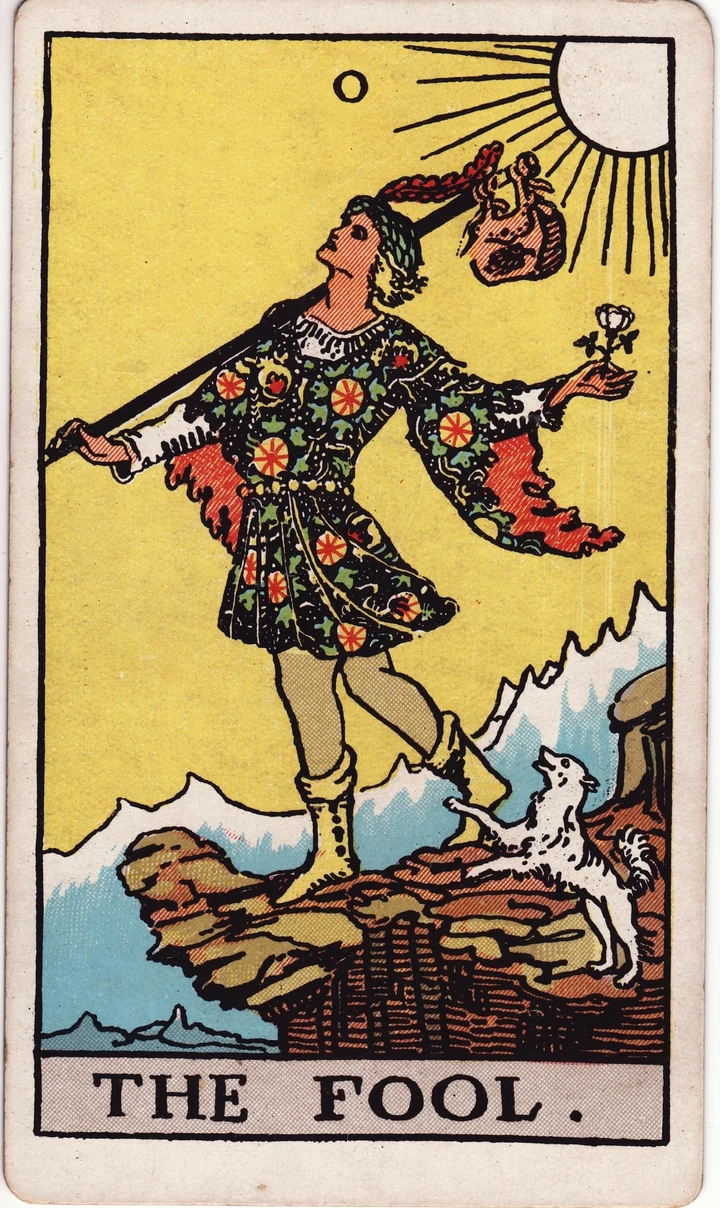
The Major Arcana · 0
The Fool
Letters and attributions follow the Hermetic Order of the Golden Dawn, whose system shaped this deck.
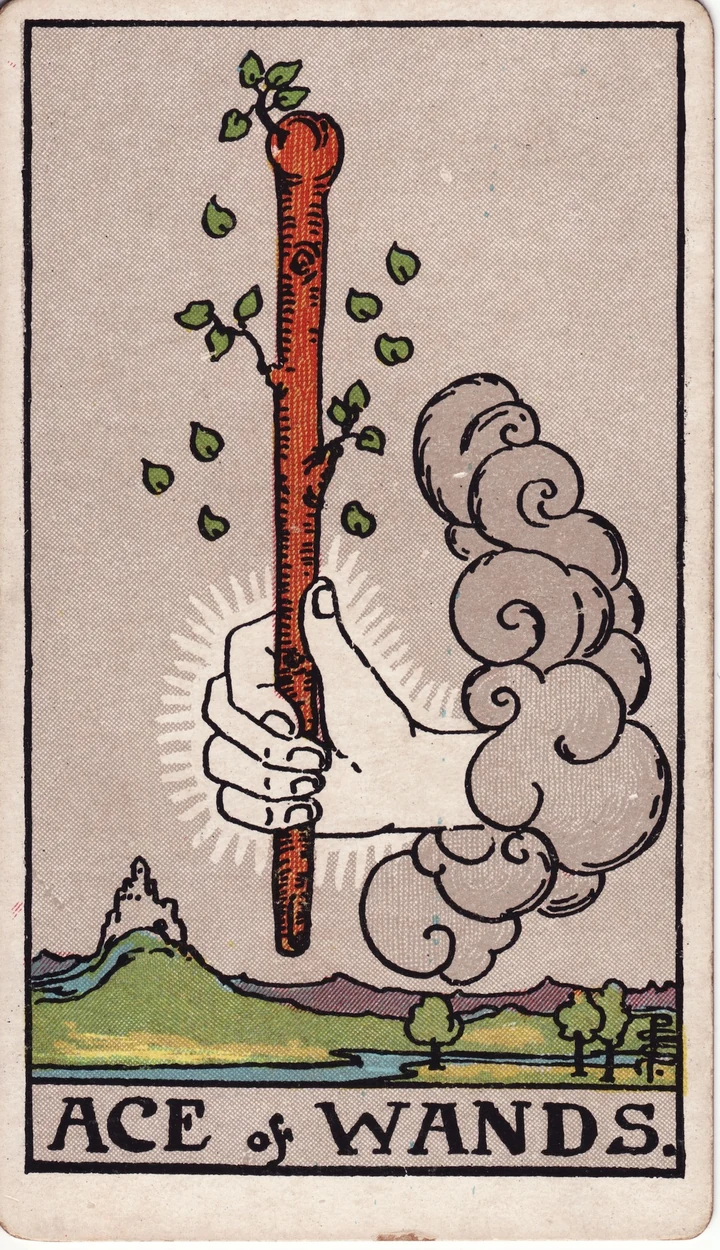
The Minor Arcana · Wands · Fire
Ace of Wands
The Fool’s journey · Know thyself
A journey of the soul
Many readers see the Major Arcana as one story. The Fool, card zero, sets out with everything still ahead. The first seven cards meet the outer world: will, intuition, nurture, structure, teaching, love and direction. The next seven turn inward: strength, solitude, cycles, truth, surrender, endings and harmony. The last seven open the spirit: shadow, breakthrough, hope, dreams, joy, awakening and wholeness.
In one old teaching, the Fool is called a fool only because he has not yet recognised the divine within him. The whole journey is that recognition. It is the inscription at Delphi, told in pictures.
The Principle of Correspondence
As above, so below
The Magician raises one hand to the heavens and points the other to the earth, the oldest gesture of the Hermetic teaching. What is above is mirrored below.
The Wheel of Fortune and the World both carry the four living creatures seen by Ezekiel and in Revelation: a lion, an ox, an eagle and a human. Christian tradition gave them to the four Gospel writers. Astrologers see the four fixed signs, Leo, Taurus, Scorpio and Aquarius, and with them the four elements, holding the turning world steady at its corners.
The four colours
Black, white, yellow and red
Four colours run through Pamela Colman Smith’s cards, and they are the colours of the alchemists’ Great Work, the patient transformation of the self.
The same four colours mark the four directions on the medicine wheels of many Plains nations, and ancient physicians once named four “humours” after them. We share these as threads in the history of ideas, never as health advice.
Aries · The Emperor
The ram and the beginning
In the Golden Dawn’s system, The Emperor belongs to Aries, and Pamela Colman Smith carved rams’ heads into his stone throne. Aries opens the zodiac at the spring equinox, when light first outweighs the dark.
Its gifts are courage, initiative and the will to build something worthy. The ram’s horns at the heart of Align With Your Divine carry the same promise: every true change begins with the courage to begin.
A gentle practice · The Hermit’s lantern
One card, one question
- 01Each morning, sit quietly and draw a single card from the Major Arcana.
- 02Look before you read: what do you notice first, and how does it make you feel?
- 03Ask its question of yourself, and write whatever arrives in your journal.
The cards do not decide anything for you. Like the Hermit’s lantern, they light one step at a time, so that you can see yourself more clearly.
Still being written
More keys to come
All seventy-eight cards are now here. Spreads, the court cards in depth and a fuller practice will follow, and members can draw a daily card in their journal.